Why do Christians fall away from the faith?
Apostasy refers to the complete rejection or forsaking of one’s faith after having been an active participant or believer. This can involve rejecting core doctrines, ceasing participation in religious practices, converting to another religion or openly opposing the former religion. It is referenced in passages such as Acts 21:21, 2 Thessalonians 2:3, or Hebrews 6:4–6.
In Ancient Greek ἀποστασία (apostasía), it meant “defection, revolt, rebellion, or abandonment.” It is a compound word of ἀπό (apó), meaning “away from,” and ἵστημι (hístēmi), meaning “I stand.” The literal sense is thus “a standing away from.” This evolved into the idea of defection or rebellion. It was first used in political or military contexts (e.g., rebellion against authority) and later applied strongly to religious contexts (rebellion against God, divine law, or the faith community). This concept of turning away from God appears throughout Scripture (e.g., Hebrew terms such as meshubah, meaning “turning away” or “backsliding” in the Old Testament).
Apostasy continues to be a problem we must face in the Church today. Many of us have known people, even loved ones, who at one point were in the church as one of us and later fell away for various reasons. Yet, a lot of Christians don’t proactively think about the factors that lead to apostasy.
It is not my intention to do a deep dive on apostasy here, though that would be a noble goal which many others have already undertaken. Instead, in this article, I want to draw our attention to one reason that Scripture gives us.
A Warning Against Immaturity
The author of Hebrews gives a very stern warning to his readers:
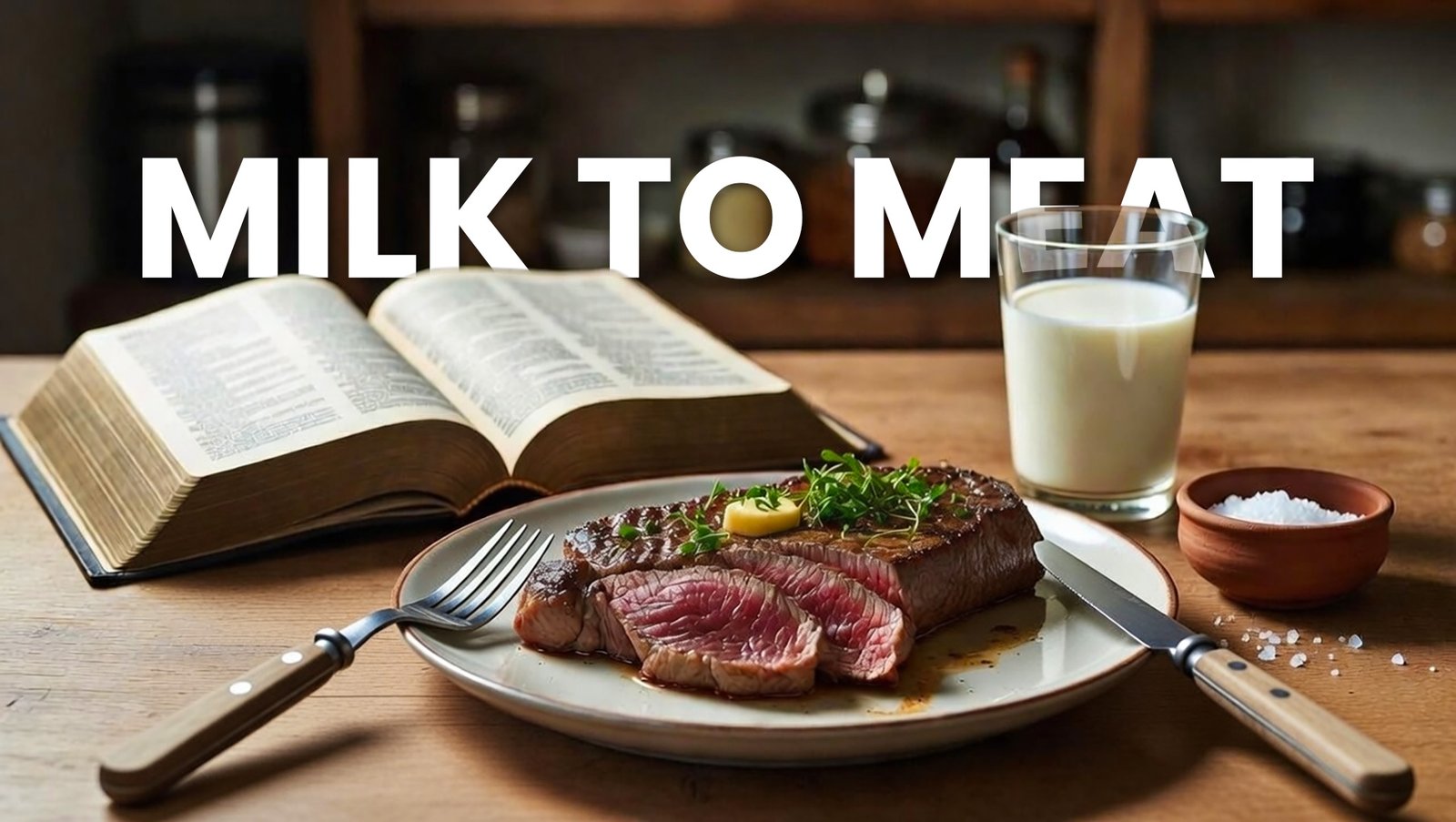
For though by this time you ought to be teachers, you need someone to teach you again the basic principles of the oracles of God. You need milk, not solid food, for everyone who lives on milk is unskilled in the word of righteousness, since he is a child. But solid food is for the mature, for those who have their powers of discernment trained by constant practice to distinguish good from evil. (Hebrews 5:12—14, emphasis mine)
There are a few important points we should note in this passage.
Firstly, notice that in the mind of the inspired author, this congregation has been in the faith long enough that they should be teaching others already. Yet they still needed someone to teach them the basics. They should already be eating “meat”.(Perhaps there is a biblical case against veganism after all!) However, just as you would be seriously worried for a grown adult to still be surviving on milk, the author of Hebrews has major concerns of spiritual malnutrition for his audience.
What caused this?
Stuck on Milk
The author’s rebuke exposes that “everyone who lives on milk is unskilled in the word of righteousness”. It seems like the core problem was that they were still unfamiliar and unskilled in Scripture. This is what it means to be spiritually immature—childish. Maturity would mean that their “powers of discernment” would be trained through practice, repeated use and improvement in distinguishing good from evil.
But this was not where they were. They were stuck on milk.
Have you ever stopped and thought about what that looks like, practically speaking? What would a Christian who is unskilled in the word and untrained at distinguishing good from evil look like? What would a church of immature Christians like that look like?
To get a clear picture, we need to understand what is meant by “the basic principles of the oracles of God.” This is what the author equates to being on milk.
What is considered milk?
The author continues,
“Therefore let us leave the elementary doctrine of Christ and go on to maturity, not laying again a foundation of repentance from dead works and of faith toward God, and of instruction about washings, the laying on of hands, the resurrection of the dead, and eternal judgment.” (Hebrews 6:1—2, emphasis mine)
Here, the author urges his audience to press on toward maturity. He says that they must “leave the elementary doctrine of Christ”. Literally, the Greek says, the beginning of Christ’s word (ῆς ἀρχῆς τοῦ Χριστοῦ λόγον ). In contrast to Jewish teachings, this refers to basic Christian teaching that all new believers should be taught. The passage summarizes these basics through three pairs of phrases.
The first pair—repentance and faith—represents the twofold nature of conversion: turning from dead works, or acts that lead to death, and turning toward God in trust. The second pair, “washings” (Greek: βαπτισμός—baptismós) and “laying on of hands,” likely refers to Christian rituals of baptism1Some commentators see this as a reference to Jewish ceremonial washings. It is an interesting debate, which we do not have space to enter into here. I think there is a strong case to be made that Christian baptism is in mind, even though there was probably a background of Jewish ceremonies, given the original audience of Hebrews. and what would become confirmation or ordination.2Laying on of hands in the New Testament was also done for healings, receiving the Spirit, and prayers of blessing. The third pair encompasses resurrection of the dead and eternal judgment.
These are what the author of Hebrews considers to be elementary Christian doctrines, the basics.
We could summarize these “elementary doctrines” as basic teaching about: salvation, church ordinances and ordination (ecclesiology), and our eternal destiny.
The Real Problem
Bible commentator, David L. Allen, notes that,
The meaning here is not that of abandoning the basic teachings of Christianity, but rather the necessity of recognizing the foundational character of these teachings and thus the impropriety of going over the same ground. The readers are exhorted to move on to another level, a level commensurate with those who are mature, a level of “fuller appreciation and application of that teaching.”
(David L. Allen, Hebrews, The New American Commentary, 339–340)
The problem was not the teachings themselves, but rather that this congregation was stuck on them—going over them repeatedly and never moving on to more. As the UBS Handbook notes,
The readers have not forgotten the basic teaching they received; they have simply lost interest in learning anything more, or in becoming better trained to distinguish good from evil.
(Paul Ellingworth and Eugene Albert Nida, A Handbook on the Letter to the Hebrews, 107)
The author urges them to “not lay again a foundation”. The Greek used is a construction metaphor. A themélios (θεμέλιος) referred to a “supporting base for a structure” (BDAG). One does not keep relaying the foundation for a building, but rather we continue to build upon it. Similarly, Christians are not to keep replacing the foundations of their faith, nor are they to get stuck on repeatedly going over it endlessly. They are expected to move on and build upon it.
The Present Immaturity in the Evangelical Church
The audience of the book of Hebrews was apparently a church that continually went over basic teaching about salvation, ecclesiology, and our eternal destiny. Does that sound familiar?

The reality is that in a significant number of conservative, Bible-believing Evangelical churches today, if you were to survey the sermons preached and the topics they covered, they would match this basic list of elementary doctrines in Hebrews 6. You would hear many “altar call” sermons about salvation, going over the basics of the Gospel and justification, urging people to repent and believe. You’d probably hear a few sermons on baptism and perhaps a mini-series on the offices and functions of the church. In many conservative churches, you’d hear about eternal judgment and the hope of the resurrection.
For many Christians, this is their steady diet throughout the year. However, according to the author of Hebrews, this is milk.
It’s no wonder so many Christians today are spiritually immature and do not have their powers of discernment trained!
Now, there is nothing wrong with milk in its proper context. Milk is for babies in Christ. Every healthy church should have a steady stream of new believers being brought in. The apostle Peter urges,
“Like newborn infants, long for the pure spiritual milk, that by it you may grow up into salvation—if indeed you have tasted that the Lord is good.” (1 Peter 2:2—3)
But note the purpose of this milk. It is so that you would “grow up.” Christians are never meant to stay spiritually immature in their thoughts, deeds or even their emotions. We are to press on to maturity in all areas of our lives.
A church that only preaches the basic elementary principles of the faith will feed the babies with milk, but the rest of the congregation will be malnourished. Thus, you’ll end up with stagnated growth.
Preachers must feed the congregation with a healthy mixture of milk and meat by declaring “the whole counsel of God.” (Acts 20:27) God’s Word is all we need for a balanced diet. It contains both milk and meat.
Given the current theological famine in the land, I would advise leaning toward going heavy on the meat.
Milk to Mush—Signs of Our Deficient Diet
If one were to survey the average Evangelical church about a range of topics, it would soon become clear that many in the congregation do not have a robust Christian worldview. Even amongst Christians who have been going to church for many years, you would encounter unbiblical beliefs about when life begins, parenting, education, sexuality, government and politics, eschatology, the arts, culture, business, and many more topics.
For example, according to surveys done by Ligonier Ministries in their 2025 State of Theology report3Data found at https://thestateoftheology.com (Accessed Feb 4, 2026), 47% of evangelicals agree that “God accepts the worship of all religions, including Christianity, Judaism, and Islam.” This pluralistic stance reflects societal pressures for tolerance or interfaith dialogue. Pew Research Center’s 2024 data4Data found at https://www.pewresearch.org/religion/fact-sheet/public-opinion-on-abortion/ (Accessed Feb 4, 2026) showed that 71% of Black Protestants support legalized abortion, and Evangelicals are lower at about 35% support, but overall Christians show majority acceptance, influenced by factors like feminism or situational ethics. They also found that 59% of U.S. self-identifying Christians say homosexuality should be accepted by society. Even though evangelicals were better, still 36% were affirming.
Recent 2024 research from the Arizona Christian University Cultural Research Center (directed by George Barna)5Data found at https://georgebarna.com/2024/08/new-research-reveals-the-limitations-of-christianity-evangelicalism-in-american-society/ (Accessed Feb 4, 2026) reveals that about 20% (one in five) of theologically-defined evangelicals prefer socialism to free market economies. A 2017 Barna Group study in partnership with Summit Ministries6Data found at https://www.barna.com/research/competing-worldviews-influence-todays-christians/ (Accessed Feb 4, 2026) found that 36% of practicing Christians (a group overlapping significantly with evangelicals, defined by regular church attendance and faith importance) accept ideas associated with Marxism, such as class struggle or critiques of capitalism’s excesses, despite Marxism’s historical atheism. Given recent events since then, the rise of BLM, the Social Justice Movement, and many other neo-Marxist ideologies, that percentage has likely grown.
Another trend has been that of Evangelicals leaving to go to other traditions that are seen as more traditional and historically robust—such as Roman Catholicism and Eastern Orthodoxy. Oftentimes, their reasons for departure have to do with the shallow depth of worship they experienced in Evangelical churches and a lack of rootedness in a historic tradition. (Both of these, I think, could be easily addressed if more Evangelicals embraced more of the Reformed tradition by using historic Creeds, Confessions and Catechisms and by following the Regulative Principle of Worship.) This trend seems to happen especially in young men who are looking for answers, but sadly don’t get much from their own pastors, who seem ill-equipped to respond. They are hungering for more than just the milk they’ve been drinking from Evangelical pulpits. By comparison to the shallowness of much of popular Evangelicalism, Roman Catholicism and Eastern Orthodoxy can seem like they offer more depth.
Now, sometimes the fault may lie with the listeners rather than the preachers. We are accountable for how we hear the Word and take it to heart (Jam. 1:22).

However, given what we have already pointed out about the majority of the content that is preached from the pulpit in the average Evangelical church, at least some significant part of the blame lies with the pastors failing to declare the whole counsel of God on all issues of life.
The fact is that many Christians today who sit under the regular preaching of the Word are not being equipped with a robust Biblical worldview to properly process issues outside of the basics of the faith. They’re being fed milk. At best, maybe we could call their discipleship “milk to mush”—they’ve got the basics, and maybe a little bit about God’s sovereignty or TULIP thrown in. But they haven’t had “their powers of discernment trained by constant practice to distinguish good from evil.” For that, you need preaching to cover a large breadth of topics, and to be applied specifically (not generically) to these various topics to train their discernment. They should be given specific situations as examples to illustrate how a particular text or doctrine applies in real life.
Immaturity Leading to Apostasy
It is not coincidental that the next thing the author of Hebrews moves on to after rebuking his audience for their immaturity is a warning of apostasy.
“For it is impossible, in the case of those who have once been enlightened, who have tasted the heavenly gift, and have shared in the Holy Spirit, and have tasted the goodness of the word of God and the powers of the age to come, and then have fallen away, to restore them again to repentance, since they are crucifying once again the Son of God to their own harm and holding him up to contempt.” (Hebrews 6:4—6)
Side-stepping (for now) the debates about whether or not a Christian can lose their salvation, this brings up the main point I want to make here:
A failure to grow in maturity and progress from milk to meat theologically can lead to the danger of falling away from the faith.
John Chrysostom (347—407 AD), in his Homily 9 on Hebrews, writes,
“But if one who has been catechised and baptized is going ten years afterwards to hear again about the Faith, and that we ought to believe in the resurrection of the dead, he does not yet have the foundation, he is again seeking after the beginning of the Christian religion.”
Chrysostom is noting that if professing Christians are constantly needing to go back to the basics of the faith, it may be a telltale sign that they were never in the faith, and thus a falling away from the faith if nothing is done
Now, in the context of Hebrews, the original Jewish Christian audience was struggling with temptations to return to the Jewish system, which had passed away with the fulfillment of Christ, ushering in the New Covenant. The author was writing to urge them not to go back to the shadows when the Substance had come in Jesus Christ. He wanted them to press on to maturity in Christ and to trust in his finished work of redemption. This is what the rest of the book of Hebrews unpacks in glorious detail. He gives them meaty doctrine to spur them on to growth and maturity.
It is the same with us today. If Christians and churches are stagnant, stuck on milk and not pressing on toward full maturity, they are in danger of apostasy.
This is because we are always in motion to some end. We are either pressing on to Christ or falling away to perdition. We are never at a standstill. You are always being discipled; it’s only a matter of by whom and for which kingdom?
When a person is ill-equipped to handle the Word of truth and untrained in discerning good from evil according to God’s Word, they are more likely to be pulled away by erroneous ideologies and ideas, leading them down a path to destruction. Unless something happens to stop that slide, they may end up falling away. It is a pattern that we see again and again with kids who grow up in church, but then go off to college, and after a few years sitting under atheistic professors, they fall away.
If all they sat under in church were repeated sermons about the basic elementary principles of the faith, but were never equipped to think Biblically about the issues of life, it’s no wonder that it is so easy for a professor to deconstruct their faith. They’ve been sent into the frontlines as unarmed spiritual infants.7Obviously, there are also other factors that lead to apostasy aside from theological maturity and knowledge.
A Theological Carnivore Diet
Many Evangelical Christians today are theologically malnourished. This conviction was the impetus for this blog and website.
I’ve grown up in the Evangelical church, between the Caribbean, the United States and Canada. I’ve had the privilege of worshipping with people from many different backgrounds and cultures—seeing God’s varied grace and work. In my early twenties, God used the study of apologetics (the defence of the faith) to really grab a hold of my heart. I’ve always been one who needed to know the reasons behind things—and it was the same for faith for me. I developed a love for studying God’s Word because I was interested in figuring out how it applied to every aspect of life. Curiosity and an unstoppable need to understand things thoroughly drove me to do my Master’s of Theological Studies, where I further developed my passion for apologetics and theology, but also added to that a deep appreciation of church history. I was in full-time ministry for seven years after seminary, where I had the opportunity to see firsthand a lot of the strengths and weaknesses of the modern church.
I surveyed the theological landscape of many Evangelical churches and Christians and saw that there was a great lack of theological maturity. Christians were unskilled at applying the Word to various issues of life outside the four walls of the church and their personal piety. In the average Christian bookstore, you would find many books on the basics of the faith (and praise the Lord for that!), but few that were addressing worldview issues from a thoroughly Biblical perspective. Even in the church where I served and taught, it felt like a lot of the discipleship material was basic. My own spiritual journey told me that if the average Evangelical was going to grow in these ways, it was likely that they would need to be fortunate enough to be in a church that preached about these things, intentionally discipled by an older Christian who could impart it, or have some sort of crisis that prompted them to research it themselves and seek out resources.
For myself, that crisis happened while I was in vocational church ministry and facing the challenges of COVID and BLM in 2020. I realized that both the Christians and pastors around me seemed unprepared to navigate these issues from a Biblical perspective. What I thought was basic biblical reasoning seemed to be overlooked or not given much thought. I saw godly men and women, who I had considered to be mature Christians, fall prey to neo-Marxist ideologies and cultural pressures. Many in the church simply did not have the theological resources to discern what was wrong with these movements, and as a result, were carried away with them.

Something was tingling in my spidey senses—I knew things weren’t adding up, but I needed help piecing it together. I had been fortunate, by God’s grace, due to my interest in apologetics, to have exposure to ministries like Apologia Studios, the Ezra Institute, Al Mohler, and others. These helped to force me to think about what the Bible had to say to issues of justice, politics and culture. Though it was a journey that had already been in motion for several years, finding myself at odds with fellow leaders and needing to have a compelling biblical rationale for our practical response to these issues, it accelerated and amplified my urgency to find solid resources that could equip me.
I did the only thing I could think of—I looked back at what the theological giants before me had written.
I started reading what the Reformers had written about government and law. I learned what Reformed thinkers like R.J. Rushdoony, Herman Dooywerd, Abraham Kuyper, and John Calvin had written about the proper role and power of the State. I dove deeper into resources from Dr. Joseph Boot, Dr. Andrew Sandlin, Dr. John M. Frame, Dr. R.C. Sproul, Dr. Voddie Baucham Jr. and many others on topics like race, gender, politics, law, education, government, culture and the arts. To my surprise, these issues were not new at all! Many Reformed and Puritan thinkers had written on these topics many years ago—they had just been forgotten or neglected.
What I found was a theological carnivore diet. Meaty doctrines. Theology to chew on… and I was hooked! Like a vegan biting into a steak for the first time, it was the nourishment I knew I needed and had been sorely lacking.8If you’ve not seen reaction videos of vegans eating meat for the first time, you should!
This, I believe, is one of the greatest needs of the Evangelical church today. Thankfully, the LORD used 2020 and the world-shaking events of that year to awaken many Christians to the need for developing a “Public Theology”. However, many still remain unaware and unequipped. I realized that, even after doing seminary and being in full-time church ministry for several years, I could be so ill-prepared and malnourished on a wide range of topics, then how much moreso for the average church-goer?
Dimmed Lights and Flavourless Salt
The culture is downstream of the church. What happens in the pulpit eventually filters down to the pews and then goes out into the world.
Our Lord says that we are the “salt of the earth” and the “light of the world”. Many Christians have been taught to think about those phrases solely in the context of Evangelism and sharing their faith. Now, that is surely in mind—part of how we are salt and light is by evangelization. However, that is not all there is to it. In context, salt was a preservative and light obviously illuminates. We are to be the salt of the earth and the light of the world. If that is what we are, then what happens when the salt loses its saltiness, and the light is hidden?
What happens is the world we currently live in—full of darkness and decay.
Christians are supposed to bring the illuminating and preserving effects of a Biblical worldview to bear on all of society, and so, transform society according to God’s will. Is this not what we pray for when we pray, “Thy will be done on earth as it is in heaven”?
Unfortunately, because much of the Evangelical church has been stuck on milk for many decades now, it has lost its saltiness, and its light has been dimmed. Many Christians today have not been taught how to “distinguish good from evil” in the spheres outside of their personal piety and church. If we are to see our societies and culture once again be strong and free, we must recover these treasures of wisdom and knowledge.
This is how societies change—as God’s transformed people transform culture through everyday faithfulness.
This website is an attempt to continue to pass along these treasures, like one hungry vegan telling others where to find steak.9I’m making a play on the original quote, “Evangelism is just one beggar telling other beggars where to find bread.” It is most commonly attributed to D. T. Niles, a Sri Lankan evangelist and ecumenical leader, though it echoes earlier thoughts from Martin Luther, who reportedly wrote on his deathbed, “We are all beggars. This is true.” I am fully convinced that if more Christians get a taste for meaty doctrines, their appetite for shallow candy-coated messages will diminish. But more importantly, they will be encouraged to press on toward maturity—to apply the whole counsel of God to the whole of life.
“And this we will do if God permits.” (Hebrews 6:3)
So, I encourage you, dear reader, to press on and seek to learn how God’s Word informs every single aspect of life—especially the areas you’ve never thought about. The areas that you are least discipled in a Biblical worldview will be the areas where Satan will most likely attack you to gain easy victories.
Footnotes
- 1Some commentators see this as a reference to Jewish ceremonial washings. It is an interesting debate, which we do not have space to enter into here. I think there is a strong case to be made that Christian baptism is in mind, even though there was probably a background of Jewish ceremonies, given the original audience of Hebrews. ↩︎
- 2Laying on of hands in the New Testament was also done for healings, receiving the Spirit, and prayers of blessing. ↩︎
- 3Data found at https://thestateoftheology.com (Accessed Feb 4, 2026) ↩︎
- 4Data found at https://www.pewresearch.org/religion/fact-sheet/public-opinion-on-abortion/ (Accessed Feb 4, 2026) ↩︎
- 5Data found at https://georgebarna.com/2024/08/new-research-reveals-the-limitations-of-christianity-evangelicalism-in-american-society/ (Accessed Feb 4, 2026) ↩︎
- 6Data found at https://www.barna.com/research/competing-worldviews-influence-todays-christians/ (Accessed Feb 4, 2026) ↩︎
- 7Obviously, there are also other factors that lead to apostasy aside from theological maturity and knowledge. ↩︎
- 8If you’ve not seen reaction videos of vegans eating meat for the first time, you should! ↩︎
- 9I’m making a play on the original quote, “Evangelism is just one beggar telling other beggars where to find bread.” It is most commonly attributed to D. T. Niles, a Sri Lankan evangelist and ecumenical leader, though it echoes earlier thoughts from Martin Luther, who reportedly wrote on his deathbed, “We are all beggars. This is true.” ↩︎